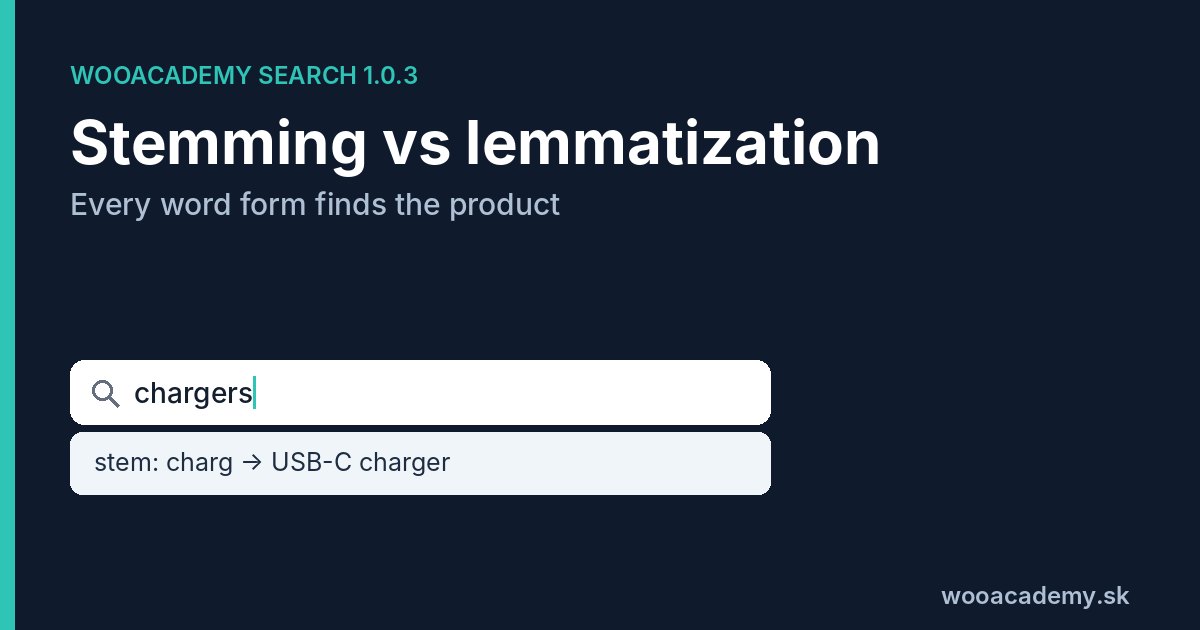



Stemming chops the ending off a word and keeps the stem (chargers, charging, charged → charg). Lemmatization finds the dictionary base form (chargers → charger, ran → run). Both make search find a product regardless of the number, case or tense the shopper uses. Stemming is fast and simple; lemmatization is more accurate but needs a dictionary and more computation.
Why it matters more for Slovak and Czech stores than for English ones
English has a handful of endings (shoe, shoes). Slovak and Czech have seven cases, three genders and dozens of declension patterns. One noun commonly has more than ten forms. A shopper types “nabíjačky na mobil” (phone chargers), the product is called “Nabíjačka na mobil USB-C”. Without handling word forms, “nabíjačky” and “nabíjačka” are two different words to the computer.
Default WordPress and WooCommerce search looks for text with an SQL LIKE condition. A partial string would match both, but the full word “nabíjačky” does not find a product that only has “nabíjačka” in its title. In English the same happens with irregular plurals and with queries such as “batteries” against “battery”.
Stemming and lemmatization compared
| Stemming | Lemmatization | |
|---|---|---|
| Principle | Rules chop off endings | Dictionary and morphological analysis return the base form |
| Output | A stem, not necessarily a real word | A real word (lemma) |
| Speed | Very fast | Slower |
| Errors | Sometimes joins words that do not belong together or misses irregular forms | Fewer errors if the dictionary knows the word |
| Best for | Real-time search, autocomplete | Text analysis, search engines with large budgets |
The Stanford textbook Introduction to Information Retrieval describes it the same way: stemming is a crude heuristic that chops off the ends of words, lemmatization uses a vocabulary and morphological analysis to return the dictionary form.
Where stemming goes wrong and how to work around it
- Over-stemming. “Universe” and “university” can end up with the same stem. The fix is a cautious stemmer that only removes common endings, plus ranking that prefers exact matches.
- Irregular forms. “Mouse” and “mice” are not joined by a stemmer. In a store this is rare, and when it happens search synonyms help.
- Brands and codes. “Adidas” must not lose its “s”. Short words, numbers and codes should stay unchanged.
How wooacademy search 1.0.3 handles it
In the plugin I chose a light stemmer for Slovak and Czech. The reason is speed: the stemmer runs on every keystroke in autocomplete and with thousands of products the result must arrive within a few milliseconds.
- During indexing, words from the title, description, categories and attributes lose their diacritics and are reduced to a stem.
- The query is processed the same way, so “nabíjačky”, “nabíjačkou” and “nabijacka” meet at the same stem.
- Short words and words containing digits are left unchanged.
- An exact match weighs more than a stem match in ranking. More on how the order is built in the article on search relevance.
- Typo tolerance runs on top of the stemmer, so it also copes with a missing letter.
Search that understands Slovak and Czech
wooacademy search 1.0.3 finds products regardless of case, diacritics and small typos. It ranks results by match, sales and stock.
I want this search on my store · annual licence for 1 domain €249, done-for-you setup €499
How to tell whether word forms cost you results
Search for five products in the plural and in another grammatical case. If the results differ noticeably from a search in the base form, your search does not join word forms. In the search terms report you will then see exactly these queries among zero results.
Frequently asked questions
Is lemmatization always better than stemming?
For text analysis yes, for store search not necessarily. Stemming is faster, and for product titles the accuracy difference is small when ranking prefers exact matches.
Does the stemmer work for English?
The wooacademy search stemmer is built for Slovak and Czech. English stores benefit mainly from typo tolerance, synonyms and ranking.
Do I have to rewrite product titles because of stemming?
No. Word forms are handled in the search index, the texts on your site stay unchanged.
What are stop words and are they related to stemming?
Stop words are very common words (a, the, for) that search ignores or gives little weight in ranking. It is a different text processing step, done at the same stage.
Author: Milan Fraňo, wooacademy.sk. I build WooCommerce stores, tracking setups and SEO. I developed the wooacademy search plugin for stores that want good search without paying a monthly fee to an external service.