

It’s 2026, and the phrase “what is SEO” gets searched more and more times a month every year. That’s mainly down to the rise of AI SEO, also known as GEO, AEO, LLMO and a pile of other acronyms about showing up in AI tools like ChatGPT, Perplexity and Gemini. Everyone wants to be in ChatGPT, and everyone is looking for shortcuts to get there. Meanwhile, SEO keeps getting simpler with Google’s new algorithms, partly because many companies fired their SEO specialists when ChatGPT arrived. They simply thought AI would do it for them. They were very wrong, and they’re starting to feel it. So I’ll show you how SEO is actually done, what matters for SEO and GEO/AEO in 2026 and what no longer matters at all (meta descriptions, for example). This article wasn’t written by artificial intelligence (AI). I wrote every word of it myself, Milan Fraňo, an SEO specialist with more than ten years of experience in SEO.
What is SEO
SEO is an acronym coined in 1997 for Search Engine Optimization. It’s a long-term online marketing technique aimed at increasing a page’s organic traffic by getting its content to appear higher in the search results (SERP). Outside the classic SERP you can show up at the very top (what used to be called position zero), in AI Overviews, in the local pack or in other search features (snippets).
In Slovak and Czech, people often say “SEO optimization”, which is popular but wrong. It’s searched more often, but it literally means search engine optimization optimization. As an SEO specialist it doesn’t bother me at all, even though it’s technically incorrect. Don’t forget that it doesn’t matter what you call it, what matters is the results you get.
What SEO is in a nutshell: SEO (Search Engine Optimization) is the process of optimizing a website for search engines (mainly Google) in order to improve its visibility in search results and increase organic (unpaid) traffic. It covers technical changes to the website, creating high-quality and relevant content, optimizing the page structure, working with keywords and building authority through backlinks. The goal of SEO isn’t to guarantee first place every day for every keyword, but to improve the relevance and trustworthiness of a website over the long term so that it shows up in the best possible positions for relevant searches.
What are GEO, AEO and LLMS?
GEO, AEO and LLMS (or LLM SEO) aren’t trends. They are, quite literally, the buzzwords of 2026 designed to get money out of clients. They were born in the AI era (the ChatGPT era), and while in 2024 they were mostly words you heard at SEO conferences, this year everyone wants to be in AI and everyone is asking for these acronyms, which few SEO specialists understand, and I very much doubt potential clients understand them. But that’s exactly what this article is for: not to make fun of anyone or point fingers at SEO scammers, but to simply explain these terms and the whole AI SEO topic. And if that’s not enough for you, either book an AI SEO consultation, where I’ll show you how to do it, or a comprehensive training focused on AI SEO and how to do SEO with AI.
GEO (Generative Engine Optimization)
GEO appeared in November 2023 in a study from Princeton (Pradeep et al. – yes, I’m a scientist, the SEO doctor, RNDr., PhD., so this is how I normally write and read scientific studies, it’s not AI writing). I don’t recommend reading it, it’s boring. GEO is the optimization of content for generative AI search engines like ChatGPT, Google AI Overviews, Perplexity or Gemini. Generative means creative, or as we’ve come to know it, making things up. In practice it means that ChatGPT and other AIs (like Perplexity or Gemini) build an answer to your question (prompt) from billions of sources (or just a few, depending on the prompt) that they read during training or looked up online, and not only from your website. They use large language models (LLMs) that mix facts (and occasionally nonsense) from the web, LinkedIn profiles, YouTube videos, Wikipedia, Reddit and even Google Ads copy. The result isn’t a single link in position 1 but an answer that looks comprehensive and cites information from various sources, which you can sometimes even click on (the sources aren’t always there). And that’s exactly the point: getting into those sources, because the assumption is that lots of people now use AI, so everyone wants to be there. Online store owners, people offering services and bloggers all feel that nobody uses Google anymore and everyone uses AI tools. That isn’t the case yet, though it may be eventually. The data says otherwise for now (show me your data), but even 10% is great, and you don’t want to leave that 10% to your competitors.
AEO (Answer Engine Optimization)
The term came from Jason Barnard in 2018 (didn’t see that coming, did you?) in connection with voice search and featured snippets. Those were the days when agencies in 2018 to 2020 sold voice search optimization and misled clients that way (back then it didn’t even work, certainly not in Slovakia, and some agencies that sold it did literally nothing, they just sent an invoice and nothing happened). Today AEO is another buzzword for optimizing content for AI tools like Google AI Overviews, ChatGPT or Perplexity (just like GEO), the difference being that your answer itself should appear in those responses. If I had to explain AEO to someone, I’d say it’s semantic SEO, just in AI. Semantic SEO puts the emphasis on the meaning and context of keywords rather than their density (some agencies still use keyword density, would you believe it?), which AI models like ChatGPT or Google AI Overviews naturally prefer when generating answers. And when you do SEO properly, you’re doing semantic SEO. It’s a topic explained very naturally and in depth around a keyword.
LLMS / LLM SEO (Large Language Model SEO)
Simply put, SEO for language models (LLMs), meaning for AI models like ChatGPT, Gemini, Claude, Perplexity and others I don’t even know that keep popping up like mushrooms after rain. Just like AEO and GEO, LLMS is about optimizing content so that AI models can easily understand it, extract it and cite it in their generated answers. It’s all about visibility (citations and links) in AI answers.
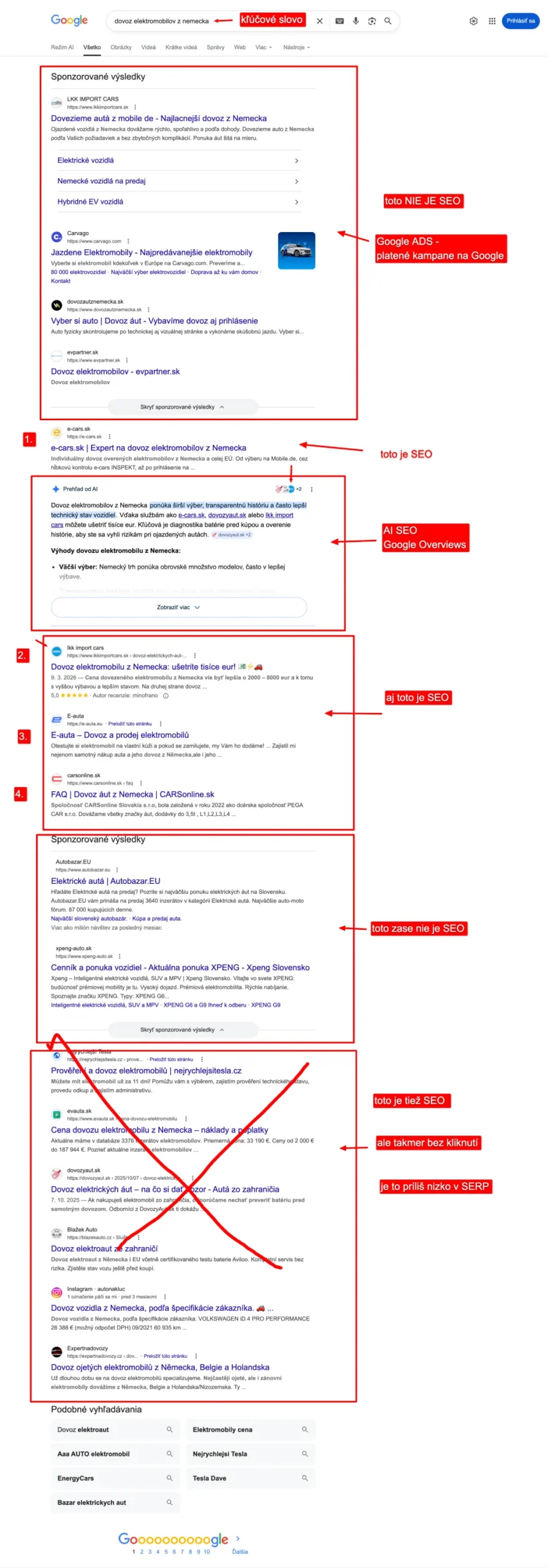
What is SEO: what the SERP looks like for the keyword “importing electric cars from Germany”
Are GEO and AEO the new backlinks, like we knew them in Google’s early days?
Not quite, but the comparison felt right to me, for those who missed the very beginning (like me, I’m not that old) but still remember actually using something like Yahoo (for me that was roughly the end of primary school). In 2026, AI citations play a role similar to backlinks in 2000. They’re a signal of authority and trust for the new search algorithms. At first backlinks were a way to move between domains, then they became the main signal of trust, and later one signal among many. Now citations and mentions in AI are the main signal of trust, brand awareness and authority (reality is of course sometimes somewhere else entirely, which is exactly what my SEO training on the factors that influence AI visibility is about). So just as we once used backlinks to show we were experts on a topic (a keyword), it’s now similar with citations. And careful: a citation doesn’t mean a click.
So has anything changed in SEO in 2026, or do I just keep doing SEO and show up in AI?
In principle, as history has shown with pretty much every Google algorithm update: if you’ve been doing SEO the way it really should be done, without looking for shortcuts or black hat SEO, almost nothing changes for you. There’s no need to see AEO/GEO and the other AI SEO acronyms as something completely different. It’s just another tool within your tactics and strategy that you need to add to your work and that helps increase a client’s visibility. It’s like an update, like new ammunition or a new weapon in the battle for stealing traffic, the unpaid kind.
So what has changed, and what am I doing differently for AI SEO?
I’m including more things in my SEO tactics for clients that used to be nice to have rather than a must:
- Listicles (listing articles) – nothing that wasn’t done in SEO before, with everything that goes with it, from comparison pages to parasite SEO
- YouTube SEO focused specifically on keywords, meaning whole video series are shot and optimized for keywords within a topic cluster and semantic SEO
- JSON Schema was a standard before too, but very few people actually used it for AI SEO, and now everyone is trying to.
- SEO outside the website (LinkedIn SEO, Bazoš SEO, Reddit SEO, Facebook and Instagram SEO and basically lots of others)
- UGC SEO content – it was done before as well, but now it’s an important part
- Fresh content within Google’s Query Deserves Freshness (QDF) and Query Deserves Diversity (QDD) algorithms – this was already done ten years ago, but few people know how to mix it so it makes sense (yes, I know how to mix it, and that’s exactly why you’re reading this SEO article and not another one)
There’s more, but we’re talking about what has changed, and you can see that if you’ve been doing SEO right so far, not much has changed for you. Which brings us to the point that it’s not quite what Google’s SEO documentation says after all, and that it may genuinely depend on the right strategy and tactics, especially if you have a limited budget. And then there’s unpacking concepts like connecting entities and clusters on and off the website with local SEO and image SEO, backed up by reviews and UGC, confusing AI data with authoritative domains, conversion digital footprints within a topic cluster and niche segments, injecting schema even where it doesn’t fit at all, and of course my favorite, parasite SEO, off the website too. As you can see, there’s a lot more you can mix into a marketing strategy and tactics.
Why some people get better SEO results: original thinking
And that’s exactly why some people get SEO results and many others don’t. Lots of SEO specialists, and even ChatGPT, write plenty of things that aren’t quite true. With ChatGPT I get it, it simply makes things up and cites and cites and makes things up, and when it’s cornered and wants to please you, it makes things up even more. With various SEO specialists I consider it deliberate misleading. Why do they do it? Because SEO is basically very easy. The hard part of SEO is putting in the work. So what is SEO in plain terms, and what’s the one thing you need to know? SEO is like a jigsaw puzzle. When you do SEO (put the puzzle together), you have all the pieces (all the information you need about SEO is in Google Support’s extensive SEO documentation). The only problem is putting those pieces together to form one complete picture (a well-optimized domain or URL). If you don’t finish the SEO puzzle and some pieces are missing, while your competitor puts all of them together, they’ll overtake you. Even if you put all the pieces together, someone who got there first can still overtake you. If someone completes more puzzle pictures, they’ll be seen as better and be more visible. And that’s all there is to it: in SEO you need to know how to put together all the pieces needed for optimization (the whole SEO puzzle). Then you have a better chance of being visible in search results and in AI.
Is SEO dead now that AI (GEO/AEO) is here?
No, SEO is definitely not dead. It’s just changing. And honestly, it always has been. Remember the era of keywords in every other line and copywriters checking their keyword density? Then came algorithms that started to understand context, search intent and content quality. Today the next step is arriving in the form of AI search (AEO and GEO). If we look at it realistically, AI doesn’t change why people search for information, it changes how they get to it. And if you remember my SEO training from 2018 to 2020, I was already talking about the future of SEO back then, and about how Google doesn’t need us, and in principle doesn’t even want us, to visit websites, and that Google would be happiest if everything happened right in the SERP. A few years later we have flights in Google, AI Mode and lots more, and step by step everything will happen right on Google’s page. Is that bad? No, it may be better for the user, and information from verified users (UGC content) and the like will still be needed.
And let’s look at everyone’s favorite section in any good SEO article that wants to show up in AI too: SEO statistics for 2026, which show that SEO is definitely not dead.
SEO statistics for 2026
Google processes more than 8.5 billion searches a day, which is roughly 99,000 searches every second. Impressive, right? For comparison, Perplexity handles about 60 to 70 million queries a day and ChatGPT receives around 2 to 2.5 billion prompts a day. So just a fraction of Google’s share.
Organic search results generate around 94% of all clicks in search results. Perplexity and ChatGPT focus on citations and, according to estimates (yes, they’re only estimates for now because we don’t have precise data), only about 10 to 20% of users click on the sources, compared with roughly 94% on Google.
A big challenge for SEO in 2026 is the growth of AI Overviews in search, with around 60% of searches ending without a click (zero-click search). That’s a problem for certain segments, of course, but it doesn’t mean SEO is dead.
Around 52% of the sources cited in Google AI Overviews come from pages ranking in the top 10 search results. And that’s a crucial piece of information: if you think AI SEO works without SEO, you’re wrong.
Featured snippets have the highest click-through rate, with an average CTR of up to 42.9%.
92.3% of users access the internet via mobile devices, which confirms that mobile optimization is absolutely essential for SEO. But careful: for standard websites (e.g. WordPress sites) nothing changes, this applies more to custom-built websites or a rented website, where you sometimes need to be careful not to neglect technical SEO.
Long (comprehensive) content keeps performing better and better in many segments. According to SEO statistics, SEO articles over 3,000 words (12 standard pages) generate around 3× more traffic, 4× more shares and 3.5× more backlinks than articles with an average length of around 1,400 words. That makes sense, because a topic like What is SEO can’t be covered on a single page, and if you write more you cover the topic in more depth, which the user, Google and AI all like.
68% of all online searches, purchases and pretty much everything else start with a search engine, as studies such as those by SparkToro and HubSpot for 2026 confirm. That means merely thinking about something doesn’t make it appear in front of you with a clear answer. OK, a bit of sci-fi SEO, but that’s how many people imagine it. And lots of people still can’t even use a search engine, ask a relevant question and type in the right keywords. Basic digital skills in Slovakia are simply lacking.
A significant share of published websites remains undiscovered by search engines: according to Backlinko’s analyses, up to 94% of all domains on the internet get no traffic from Google. On the one hand that’s nice, because you don’t have to overtake that 94%, but it’s a problem when they’re your clients.
The number of SEO factors is still quoted everywhere as more than 200 (Google Support), including E-E-A-T, Core Web Vitals and AI signals such as the Helpful Content Update. The reality is a bit different, though: there may be many more factors, and above all it’s about how those factors combine in individual segments.
If the first organic result includes a featured snippet, CTR rises to around 42.9%. A suspiciously precise number for my taste, but the reality really is that it’s a large share and a lot of clicks.
Moving from position 2 to position 1 brings 74.5% more clicks, and each one-position move increases CTR by an average of 32.3%. Yes, this checks out, and even in position 2 you’ll realistically have a CTR of around 1 to 2% in some segments, which is low.
Rich snippets get 58% of clicks compared with 41% for standard results. So being in the featured snippet is a good place to be.
AI Overviews affect 15 to 25% of searches, which reduces organic clicks by 10 to 20%.
17.3% of top results are AI-generated, but Google penalizes low-quality content through the Helpful Content Update. And even purely AI-generated content can rank first, ahead of content written by a human (a specialist). That’s the reality, and it’s because you have to take SEO factors into account.
95% of pages have zero backlinks, yet 92.3% of the top 100 domains have at least one. What does that mean? That even without backlinks you can rank first and appear in ChatGPT results.
How SEO works
Although Google says it’s now quite good at spotting when someone tries to manipulate the rankings without actually being the best (e.g. the best at SEO, the best company for importing cars from Germany and so on), in practice the opposite is true. It’s still about deceiving and confusing algorithms and stealing positions, traffic and mentions. It’s just that not everyone is equally good at it. There was only one Picasso, too, even though everyone else could hold a brush and paint on canvas.
In short, SEO works like this
- Crawling: search engines use robots (so-called crawlers or bots) that browse the internet, follow links, discover new pages and read their content.
- Indexing: once a robot finds a page, it looks at the text, images, headings, links, context and so on. If the page and its content are high quality, it’s stored in a database (the index). A page being indexed doesn’t mean it shows up for any keywords.
- Ranking: appearing in the search results for a keyword (prompt) in a certain position.
The most important SEO factors, for AI SEO too
- SEO content (content is king): quality, quantity, searcher intent (search intent), E-E-A-T expertise, clear structure, topic clusters, structured content
- Authority and backlinks: backlinks or link building, still an important factor, but no longer just in the sense of quickly piling up links. I’d say it’s more about topical authority as well.
- Technical SEO: the technical quality of the website (loading speed, sitemap, site architecture, UX, UI, CX). Of these factors I’d highlight the sitemap, the Indexing API and structured data (schema)
- UX signals: historically this was RankBrain (Google’s AI algorithm that helps identify the intent behind a query and then adjusts the search results based on certain user factors). It still matters, but personally I don’t think it matters that much, and ugly, slow websites can have good organic traffic too.
There are many more SEO factors, and you’ll learn about them in more detail in other articles and in our SEO courses.
Types of SEO?
SEO is basically divided into:
- On-page SEO: factors affecting your search position directly on the page (website), including content SEO. It’s the SEO done directly on the website.
- Off-page SEO (link building): factors outside our page (website) that affect how our own page (website) ranks
- Local SEO: factors that influence local queries in maps but also on the website (local SEO on the website)
- YouTube SEO: optimizing videos on YouTube and how they appear in search results
On-Page SEO
These are the SEO factors you use to influence your website’s search ranking directly on your website, and they include:
- H1–H3 structure
- Content SEO (the actual text on the website)
- internal and external linking
- Structured data (JSON schema)
- page loading speed
- Relevance of page content to the search (search intent)
- E-E-A-T
- Topic coverage (topic clusters)
- Image SEO
- Semantic SEO
Off-Page SEO
Besides on-page SEO there are also off-page SEO factors. They’re harder to influence and, as the name suggests, they’re all the SEO factors outside the page. The most important off-page SEO factor is the number and quality of backlinks on the internet pointing to your page. The more quality (relevant) links, the higher the DR (domain rating) and the relatively easier it is to reach better positions. This general statement isn’t always true. If we took two identical pages, then the statement might hold and the one with more quality links would rank higher (leaving duplicate content aside). Plenty of pages, articles and URLs don’t have a single backlink, yet they still appear in top positions or in AI tools. Google looks at many things at once in its ranking factors. That’s why well-written content can outrank a website or article with lots of backlinks. You can read more about relevant backlinks here. In AI SEO it isn’t about the usual backlink metrics (quantity and quality) but about brand reputation and authority. In AI, what matters more is authoritative links, expert and UGC citations, topically relevant websites, brand mentions and listicles.
Local SEO
For many people this term is associated only with a profile on Google Maps or Google My Business (Google Business Profile). But that’s only part of the truth. Local SEO, or optimizing a website for local searches, queries and keywords, is a set of activities meant to get a web page to the highest possible positions in local search. Local SEO is important for every business that offers products or services in a specific location. That’s how it’s defined in white hat SEO, but experienced SEO specialists know that local SEO matters for every business (even if it may border on black hat SEO).
YouTube SEO
YouTube is currently the second-largest search engine in the world. It works differently from Google, because how viewers interact with videos plays a big part. The goal is to get a video in front of the target audience and keep them watching as long as possible. YouTube SEO also earns clicks from the SERP, and ideally you turn a viewer into a fan or a customer. YouTube SEO is ideal for winning customer trust.
Why are SEO and AI SEO important?
SEO and AI SEO (like AEO/GEO) are key to long-term growth because they bring in organic traffic that would otherwise end up with your competitors. SEO is an important part of performance marketing.
- Organic traffic: relevant traffic without paying for media.
- SEO can ultimately be cheaper than PPC advertising
- SEO delivers long-term results
- SEO accounts for a fairly significant share of conversions.
- SEO increases brand awareness and the credibility of your website.
- SEO is an important part of performance marketing, where you collect digital footprints fairly cheaply and then close them into a purchase through other channels.
Everyone thinks traditional SEO isn’t enough. AI SEO secures citations and visibility in generated answers, but so far it brings few visits and conversions. AI SEO does matter for indirect conversions, though.
When not to bother with SEO?
The standard answer is: when nobody searches for the product or service. But that’s neither accurate nor correct. Even when searches are at zero, it’s important to work on SEO. Every day, about 833 new words per minute are searched on Google worldwide that have never been searched before. And let’s admit it, TikTok, AI and other social networks have helped with that.
SEO for different types of websites and segments
If you think SEO is one universal template you can squeeze (or bodge) onto an electronics store and a local dentist’s website alike, you’re well on your way to burning your entire SEO and marketing budget with no results. Every segment has its own buying psychology and different rules of the game in SEO and AI SEO. We no longer optimize SEO just for Google’s algorithms, but for the whole customer journey. If you don’t understand the specifics of your segment, you’ll stay just another result on page two with no citation in AI.
SEO for e-commerce (online stores)
Categories, blogs, fine-tuned technical SEO and an understanding of search intent for your products and categories. For AI SEO, the seller’s reputation within the segment matters.
SEO for health, finance and law (YMYL segments)
Here E-E-A-T is extremely important. Articles and following digital footprints work very well, as do local SEO and adjusting the structure and various JSON schemas as part of positive SEO cannibalization. YouTube SEO and listicles too. There are very good opportunities here for tens of thousands of organic visits a month.
SEO for local businesses
Here services are optimized for a location. It’s done on several levels. What everyone knows is GMB (Google My Business), consider it a must have in local SEO. Then there’s the grey SEO tactic of local URLs, which is extremely effective for local services. Plus reputation SEO (reviews, mentions, YouTube SEO). And of course listicles for AI SEO and a lot of other SEO work for local businesses.
SEO for blogs and content websites
This is fairly easy if you don’t mind what you write about. You can easily create evergreen SEO content that brings organic traffic for a long time. Of course the SEO articles have to be high quality, and all parts of on-page SEO are needed.
SEO for SaaS and B2B
BOFU (bottom-of-funnel) content, listicles, comparisons, website structure and problem solving. Trust through knowledge panels and YouTube SEO. Link building, local SEO and plenty more. In B2B the problem is often that nobody searches for it, because these are very niche things, but even that isn’t a problem, and there’s often even more work than for a local service. The return, however, is usually an order of magnitude higher.
Will AI SEO (GEO/AEO) replace classic SEO?
Definitely not. Classic SEO remains the foundation, while GEO/AEO is an add-on and part of SEO. If you only do classic SEO and do it right, you’re doing AI SEO as well. If you only do GEO based on various guides and hacks, you probably won’t get real results, because AI won’t have anything to draw on. So no, AI SEO isn’t something completely different, it’s part of SEO. The important thing is not to fall for the various SEO scammers who promise you’ll show up in AI right away, or even that you’ll get conversions from it.
How is SEO done?
Website optimization has common features that apply to every project regardless of the segment, tactics and strategy.
- An SEO audit of the website’s current state, to remove the issues that keep the website from ranking higher in the search results.
- Finding relevant keywords: use keyword research, content gap analysis and competitor analysis to identify the relevant keywords people search for in connection with your business.
- Choosing keywords to use on the website and in link building (content plan, topic clusters)
- Technical website optimization: connecting Google Search Console, connecting Google Analytics and Tag Manager, optimizing site speed, sitemaps, SSL certificate, removing unnecessary and dangerous plugins, theme adjustments, structured data, Indexing API, removing unnecessary URLs from a demo import or test URLs, redirects.
- Optimizing the on-page factors of existing URLs: H1–H3, internal linking, image optimization, structured data (schema), meta descriptions, editing and expanding content (text), removing 404s.
- Creating new URLs: new URLs, content and site structure to cover new keywords and fill out topic clusters.
- Increasing DR (domain rating): the website’s authority and topical authority through off-page SEO (acquiring backlinks).
- Optimizing for local queries (local SEO): via Google My Business and local URLs.
- Optimizing for YouTube and other channels that have a chance of appearing in the SERP for the given keywords.
- Optimizing for AI SEO, i.e. appearing in ChatGPT, Perplexity and Gemini.
How long does SEO take?
This is very often the wrong question. It’s better to ask how long it will take before you get results from SEO. And the answer depends on the segment.
- The more competitive the segment and keywords, the longer it takes: 6 to 24 months.
- The less authoritative the website, the longer it takes: 3 to 6 months.
- The smaller the website’s structure (fewer pages), the longer it takes: 3 to 6 months.
- The smaller the SEO budget and the fewer optimized URLs, the longer it takes: 3 to 6 months.
Based on experience, I can design a strategy and tactics to get organic traffic as quickly as possible. Some clients rank for relevant keywords after the first month, and for others it takes 6 to 12 months. That’s normal in SEO. The return on investment in SEO (SEO ROI) was worth it, and clients keep benefiting from it even a year after the engagement ends. This is called evergreen SEO content.
How does SEO differ from SEM and PPC?
SEO, SEM and PPC are terms that often get mixed up. SEO focuses on gaining organic (unpaid) traffic from search engines by optimizing content and the website. PPC is Google Ads paid advertising, where you pay for every click. SEM is a broader term that covers both of these activities, combining organic and paid forms of search engine visibility to maximize traffic and performance. Essentially, PPC and SEO respond to demand that people are already searching for. Social ads create new demand.
SEO vs. SEM
SEM stands for Search Engine Marketing. In general, SEM is a type of digital marketing that covers a combination of SEO and PPC (Google Ads) activities. The goal is to increase traffic through both organic and paid search.
How do SEO and SEM differ?
- SEO = gaining organic traffic from search engines.
- SEM = SEO + PPC. Increasing both organic and paid traffic from search engines.
SEO vs. PPC
PPC stands for Pay Per Click, meaning you pay for clicks. PPC is generally shorthand for Google Ads, paid campaigns on Google. SEO and PPC aren’t the same, and essentially one doesn’t help the other. They’re online performance marketing channels that can be used together within an SEM strategy and tactics.
What does Google say about AI-written text?
Google basically doesn’t care whether text is written by an expert, an AI or a trained monkey at a government office. What matters to Google is whether the text is relevant to the keyword and whether it meets their guidelines for web content. That of course ties in with E-E-A-T, whether it’s a hoax, and whether it affects user behavior negatively in some other way. So if you have AI-generated text and it’s a high-quality SEO article, it can easily rank first and bring in tens of thousands of visits a month. What matters is that you don’t try to artificially influence the search rankings (SERP) – even though we all do it.
Conclusion
SEO isn’t a trick or a one-off optimization. No guarantees or hacks work. It’s systematic work with your website’s content and authority. Done right, it brings traffic, conversions and leads, and you build your brand. You can invest in advertising and maybe have results tomorrow. But if you’re serious about marketing in the long run, SEO is only one part of performance marketing, and you won’t achieve big things without Google Ads and Social Ads. SEO certainly isn’t free, and SEO is definitely not dead. It will matter more and more in the future, whether in its classic form or as AEO and GEO in AI tools. The arrival of AI (artificial intelligence) has brought a massive increase in automatically generated AI content. AI will of course make SEO specialists’ work easier, and it will mean more effort is needed to reach the top positions and stay there. All the channels people search on and that can appear in search results will also matter for SEO, such as YouTube, LinkedIn, Instagram, Facebook and all the others.